64 posts tagged with "GEME"

GEME Composter product news, activities or other information

View All Tags

What Can You Put in an Electric Composter? Meat, Dairy, Bones (Clear Rules + Hard Limits)

· 5 min read
Moore
Moore
Tech Writer, Meteorology Journalist, Gardening Lover

Evidence Header

One-sentence takeaway

Most people don’t need a fantasy list—they need a decision system: meat/dairy can be OK in normal leftovers when the process stays aerobic, but large dense bones and shells are hard limits, and “wet + greasy + dense” loads raise odor risk.

Why it matters in the kitchen

This question decides adoption. If users can’t load real leftovers, they won’t keep the habit. If they load “hard-no” items, they blame the machine. Clear rules protect both user experience and output quality.

What we tested (high-level, no secrets)

We assessed typical leftover categories (cooked meals including meat/dairy) for workflow stability and odor-risk behavior under normal loading, plus failure cases tied to density, hardness, and excess liquids.

What we didn’t test / not claiming

We are not claiming every meat/dairy scenario works equally. We are not publishing microbial composition or control thresholds.

Methods & boundaries

Methods & boundaries → Open GK Verification

Can you Put Meat and Bones In Composter?

Can an Electric Composter Handle Salt & Oil? Boundaries for Real Leftovers (Without the Myths)

· 5 min read
Moore
Moore
Tech Writer, Meteorology Journalist, Gardening Lover

Evidence Header

One-sentence takeaway

Salt and oil don’t “kill composting.” They narrow the aerobic window—so the winning strategy is simple: protect oxygen flow, manage moisture, drain free liquids, and don’t dump brine or fryer oil.

Why it matters in the kitchen

This is the #1 trust question. If a brand dodges salt/oil, it’s not honest. If a brand claims “everything works,” it’s not engineering. Clear boundaries reduce smell, reduce user error, and protect output quality.

What we tested (high-level, no secrets)

We evaluated performance across realistic leftover patterns (lightly seasoned → sauce-heavy → oily/salty) and tracked behavioral outcomes: odor risk signals, cycle stability, and whether the mass stayed aerobically active under normal household use.

What we didn’t test / not claiming

We do not claim unlimited brine/grease tolerance. We do not claim identical results across every household diet. We also don’t publish proprietary control parameters, microbial composition, or internal thresholds.

Methods & boundaries

Methods & boundaries → Open GK Verification

GEME Composting Soil and Oil Guide

The Science of Smell: Why Home Composter Filters Last 3 Months (Not 12)

· 5 min read
Moore
Moore
Tech Writer, Meteorology Journalist, Gardening Lover

Introduction: The "Sour Smell" of Reality

You invested in a premium electric composter like Reencle™ or Lomi™. For the first few weeks, it was magic—your food scraps vanished into “compost”. But around the 8-week mark, a distinct, sharp acidity (reminiscent of vinegar or pickling brine) began to permeate your kitchen.

Consulting the manual, you see a recommended filter replacement cycle of 9-12 months (Reencle) or 3-6 months (Lomi). This leaves many users wondering: Is my unit defective? Am I using it wrong?

The answer, based on adsorption kinetics and environmental engineering, is likely no.

This article explores why the physical limitations of activated carbon in high-humidity environments make a 2–4 month lifespan not just common, but scientifically inevitable.

Lomi Composter Carbon Filter

Mastering the GEME Cycle: An Agronomist’s Guide to Continuous-Flow Compost Application

· 4 min read
Dr. Kyung-Ryong.H
Dr. Kyung-Ryong.H
PhD in Soil Microbiology & Agronomy, 30+ Years Experience

Introduction: Embracing the "Continuous" Ecosystem

As an agronomist with over three decades of experience in soil health, I often see home gardeners treating all compost the same. However, the GEME Bio-Composter operates differently from standard batch dehydrators. It uses a Continuous Flow Workflow ("Add & Forget").

This means that at any given moment, the machine contains material in various stages of decomposition: 90% finished microbial humus and 10% partially broken-down matter.

This is not a flaw; it is a biological characteristic.

To use this output safely and effectively, we must move beyond simply "dumping it in a pot." We need to apply standard agricultural practices: Screening (Inoculation) and Soil Capping (Buffering). This guide will teach you how to protect your plants while maximizing the biological power of your GEME.

Countertop Composter Is a Misnomer: Where an Electric Composter Actually Belongs in a Real Kitchen

· 6 min read
Moore
Moore
Tech Writer, Meteorology Journalist, Gardening Lover

Evidence Header

One-sentence takeaway

Most “countertop composters” end up off the countertop—because real kitchens don’t want a waste machine next to food. The winning setup is floor/cabinet placement + hands-free loading + close-and-forget cycles + continuous input (no batch storage). (The Spruce Eats / Lomi guidance)

Why it matters in the kitchen

If the device can’t live where people actually keep waste (near the bin, under-counter, or on the floor), the habit breaks: scraps pile up, odors return, and “composting” becomes another chore.

What we tested (high-level, no secrets)

We evaluated “daily-use friction” through practical kitchen workflows: one-hand vs hands-free loading, lid closure reliability, placement constraints (counter vs under-counter vs floor), and drop-in cadence—focusing on the behaviors that determine whether people keep using the system.

What we didn’t test / not claiming

This is not a universal statement about every household layout or every brand/model. Placement depends on space, airflow needs, and noise tolerance. We also do not claim that a name (“countertop”) guarantees performance or compost quality.

Methods & boundaries

Methods & boundaries → Open GK Verification

GEME Composter

Top 5 Electric Composters on Amazon: 2026 Buyer’s Guide

· 13 min read
Moore
Moore
Tech Writer, Meteorology Journalist, Gardening Lover

Introduction: The Real Cost of a Kitchen Composter

Here’s something Amazon listings won’t tell you. That $500 machine you’re eyeing might end up costing you another $500 in filters before you’ve owned it for three years.

I’ve spent weeks digging through specs, user reviews, and official support pages to figure out which electric composters actually deliver on their promises. Not just the marketing promises about “saving the planet,” but the practical promises about saving you money and producing something useful for your garden.

The short answer? The GEME Pro is the best electric composter on Amazon if you want real compost, zero recurring filter costs, and enough capacity to handle a busy household.

Let’s break down the top five contenders so you can make a choice that doesn’t come with buyer’s remorse three months later.

GEME Composter

GEME Terra II: The Pros and Cons

· 11 min read
Moore
Moore
Tech Writer, Meteorology Journalist, Gardening Lover

Introduction: What You Actually Get With GEME Terra II

Let me start with something that might surprise you. Most kitchen composters aren't actually composters. They're dehydrators dressed up in fancy marketing. They grind your food, bake it dry, and hand you back a pile of sterile dust that sort of looks like dirt.

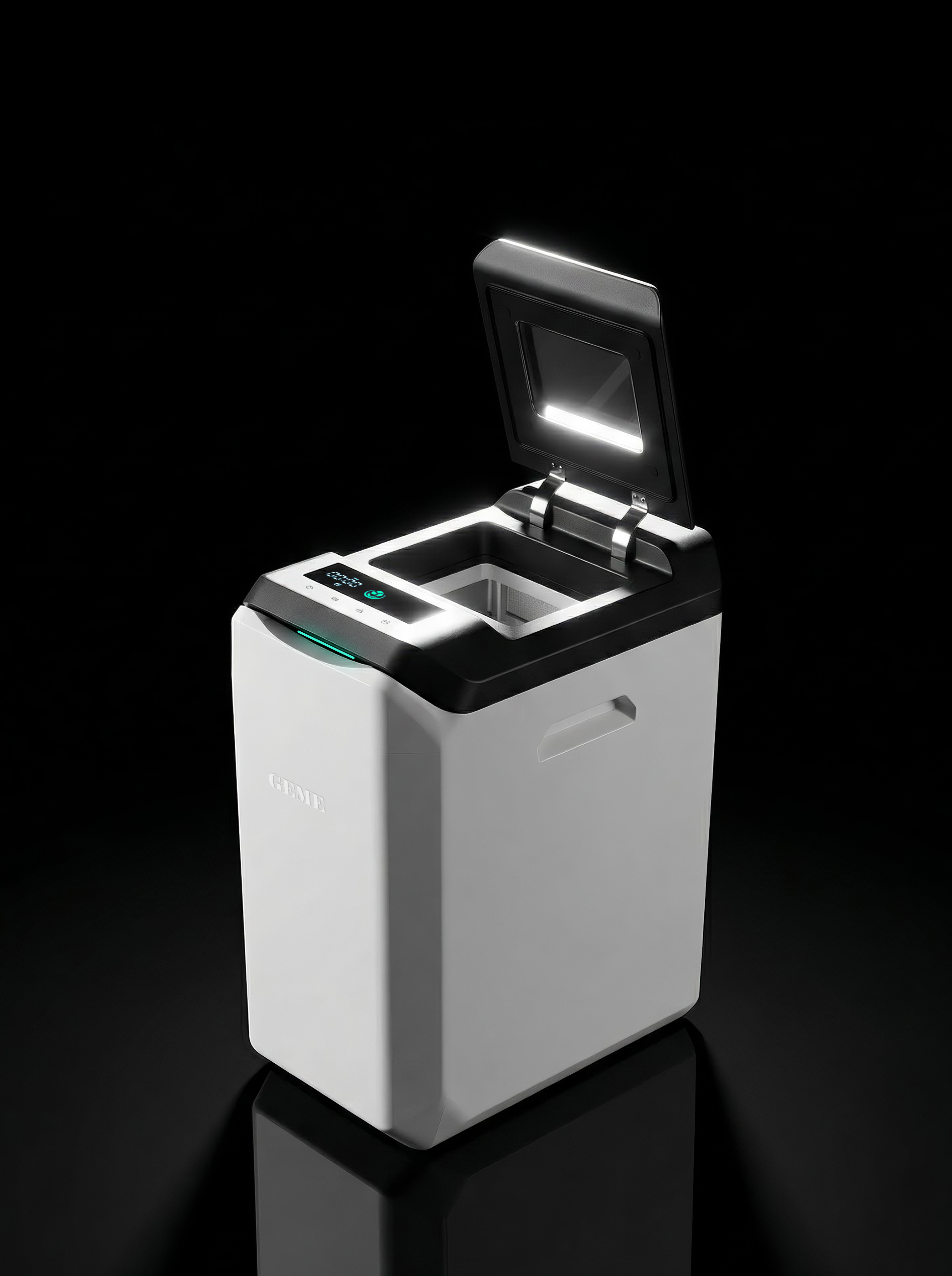
The GEME Terra 2 is different. It uses live microorganisms actually to digest your food waste. Think of it less like a food processor and more like a tiny, hungry ecosystem living on your kitchen floor.

Spec Sheet of GEME Terra II

SpecValue
Daily CapacityUp to 2 kg
Chamber Size14 liters
Noise Level35–40 dB (whisper quiet)
Filter Cost$0 (permanent)
Energy Use~1.4 kWh/day

I've spent a lot of time digging through what this machine does well and where it might not fit your life. Because no product is perfect for everyone, and pretending otherwise wastes your money and my time.

So here it is. The honest breakdown of the GEME composter, no fluff, just what you need to know.

GEME Composter

Top 5 Kitchen Composters: Pros and Cons

· 13 min read
Moore
Moore
Tech Writer, Meteorology Journalist, Gardening Lover

Introduction

Here's the thing about kitchen composters. Most of them don't actually make compost.

When you dig into the science, a lot of these machines are just fancy dehydrators. They grind your food, bake it until it's dry, and spit out something that looks like dirt but acts like dust.

I spent the last few weeks digging through reviews, spec sheets, and actual user experiences to figure out which machines are worth your money and which ones will leave you wondering why your plants look sad.

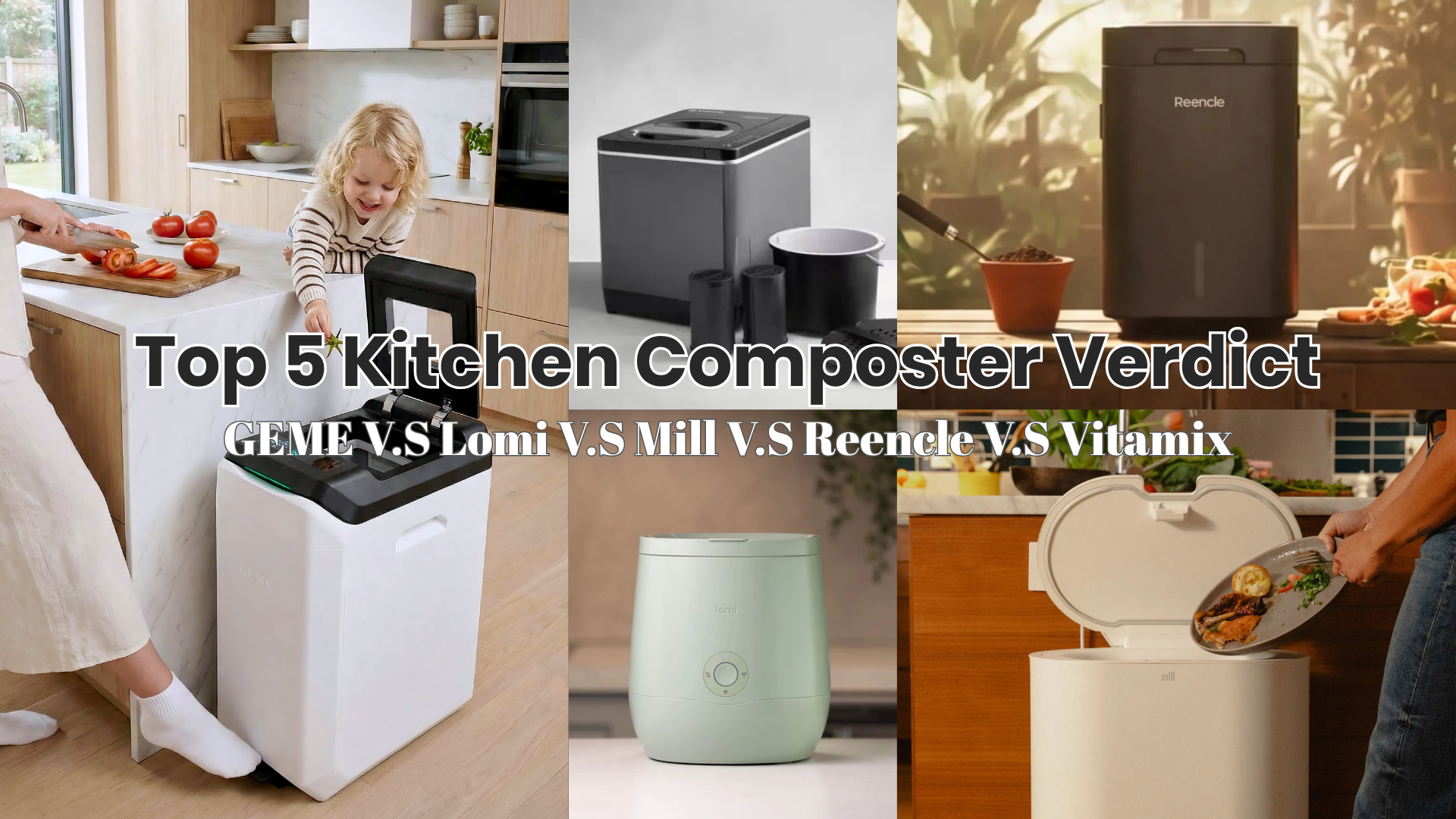
In this guide, I'm breaking down the top five kitchen composters on the market: GEME Terra 2, GEME Pro, Lomi, Mill, and Reencle. We'll look at what each one actually does, what it costs to own, and whether the output is something you'd actually want to put on your garden.

Spoiler alert: Only two of these produce real compost. The rest? They're really good at drying garbage.

GEME Composter

GEME Composter Review: Best Indoor Composter 2026

· 7 min read
Moore
Moore
Tech Writer, Meteorology Journalist, Gardening Lover

If you want a kitchen composter that actually produces real compost, handles a broad range of food waste, and eliminates recurring filter costs, a microbial machine like the GEME Electric Kitchen Composter is among the best options available today. Unlike dehydrators (e.g., Lomi), GEME Composter creates real compost instead of dried grindings.

Home composting has never been more popular. Many city dwellers and eco‑conscious homeowners want to reduce landfill waste and use their kitchen scraps to enrich soil, but traditional composting methods take time, space, and effort. Electric composters have risen to meet that demand, but not all are created equal. Here’s where GEME stands apart.

GEME Composter

The Best Kitchen Composter Verdict 2026

· 15 min read
Moore
Moore
Tech Writer, Meteorology Journalist, Gardening Lover

Looking for the best composter that frees you from endless refills and filters? Our analysis shows the world’s first AI-powered GEME Terra II stands out by eliminating recurring costs entirely (no subscriptions, no filter replacements ) while producing true soil-ready compost in hours.

In contrast, popular kitchen appliances like the Lomi 3, Mill Kitchen Bin, and Reencle Home Composter rely on heat or microbes but come with ongoing fees (carbon filters, microbe packs, or monthly plans) and often yield only pre-compost that needs extra curing.

We’ll compare costs, features and outputs of dehydrator-style units versus microbial composters, highlighting how GEME Terra II’s no-subscription model wins hands-down. Along the way, interactive tables and charts break down long-term expenses, maintenance, and real compost quality.

By the end, you’ll see why GEME Terra II is the best composter for avoiding recurring fees, saving money and hassle while delivering genuine, nutrient-rich soil for your garden.

The Best Kitchen Composter: GEME Terra II